Ever wondered how old your dog really is in human years? The old 'one dog year equals seven human years' rule is outdated. Leading scientists have developed a precise formula based on DNA methylation changes—the molecular markers of aging—that shows dogs age much faster early on than we thought.
Dogs live alongside humans, sharing similar care and environments, making them ideal for cross-species aging studies. Like us, they gray, slow down, and face age-related diseases, but their molecular aging accelerates rapidly at first, then tapers off.
'A 9-month-old dog can have puppies, so the 7:1 math doesn't add up,' explains senior author Trey Ideker, PhD, from the University of California, San Diego. 'Surprisingly, a 1-year-old dog is physiologically like a 30-year-old human.'
DNA itself remains stable, but chemical tags called methylation patterns shift with age, acting like 'wrinkles in the genome.' 'It's like gauging someone's age from facial lines and gray hair—these are molecular equivalents,' Ideker says.
Researchers analyzed 104 Labrador retrievers, from week-old puppies to 16-year-olds, collaborating with experts Danika Bannasch, PhD, from UC Davis, and Elaine Ostrander, PhD, from the National Institutes of Health. Comparing methylation to humans yielded this formula: human age = 16 ln(dog age) + 31. An 8-week-old puppy equates to a 9-month-old infant—both teething stages. A Labrador's 12-year lifespan matches a human's 70 years.
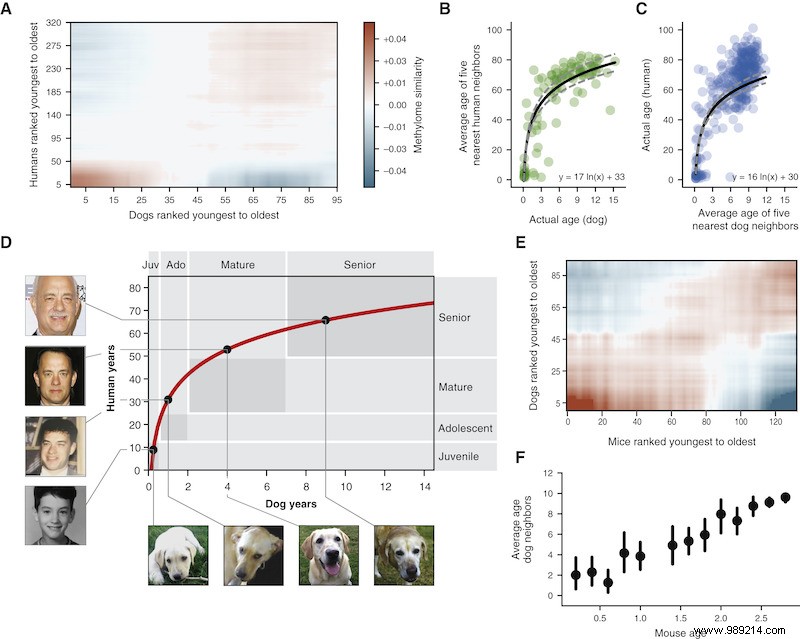
'I run with my dogs, so now I sympathize more with my 6-year-old—she's like 60 in human terms,' Ideker notes.
Methylation changes target developmental genes active in growth, which 'smolder' post-maturity. Ideker's team created a multi-species 'clock' from these, outperforming single-species models. Future studies on diverse breeds could refine it, aiding vets in proactive care and deepening interspecies aging insights.
